


In the ever-dynamic realm of luxury goods, the Swiss watch industry continues to hold a place of distinction, symbolizing not just craftsmanship and heritage but also – and quite surprisingly – economic resilience. This analysis delves into the recent performance of the Swiss watch sector, as we dive into the latest statistics released by the Federation of the Swiss Watch Industry.

January witnessed the Swiss watch exports growing by 3.1% compared to the previous year, reaching a commendable figure of 1.9 billion francs. This growth, albeit at a decelerating pace, underscores a sustained demand for Swiss watches. The increase was predominantly fuelled by exports of watches made from precious metals, which soared by 13.4% in value.

However, the industry saw a mixed performance across different materials. Steel and bimetallic watches experienced a slight decline, with values dropping by 2.8% and 3.2% respectively. This contrasted with the physical volume of steel watches exported, which actually increased by 3.4%, indicating a price-sensitive market segment that still values the Swiss mark but at more accessible price points.

The granularity of market preferences becomes even more evident when dissecting performance by price segment. Watches priced below 200 francs saw a 5.5% increase in the number of items exported, driven largely by the ‘Other materials’ category (bioceramics perhaps…). Yet, their overall value witnessed a 4.3% decline, primarily due to the diminished appeal of steel watches within this bracket. Conversely, the high-end segment, with prices above 3,000 francs, burgeoned by 4.3%, encapsulating all the sector’s growth. This bifurcation underscores a polarizing market where luxury and value segments thrive, while the middle market remains static.
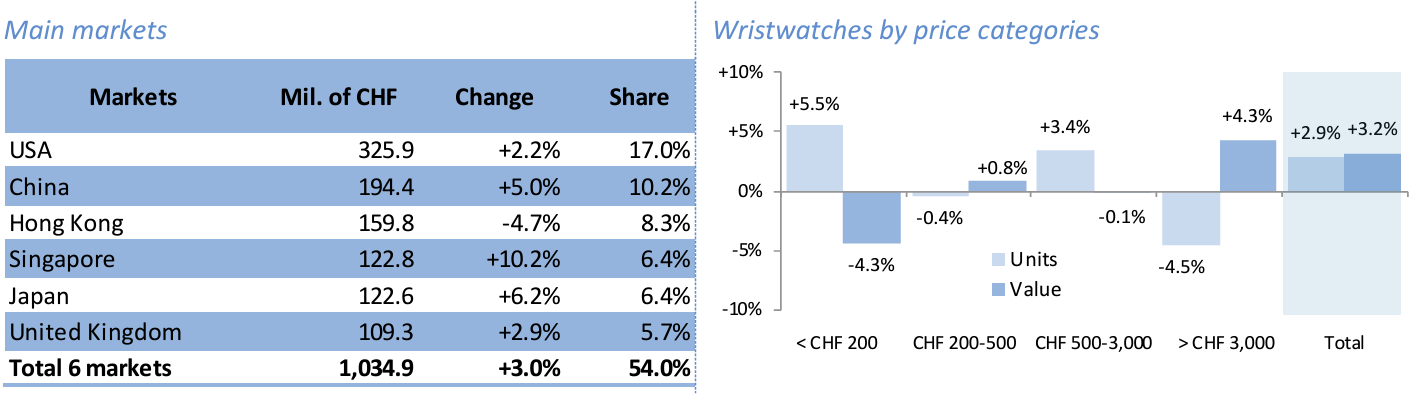
The United States and the majority of Asian and European markets exhibited growth, with the US market expanding by 2.2%. This positive trend in diverse markets indicates a robust demand base for Swiss watches, resilient against the backdrop of global economic uncertainties. However, exceptions such as Hong Kong and Germany, which saw declines of 4.7% and 11.4% respectively, reflect localized economic challenges or shifts in consumer preferences. Meanwhile, Singapore and Qatar emerged as bright spots, with Singapore enjoying a 10.2% uptick and Qatar witnessing a staggering 118.4% increase, likely buoyed by the Doha Jewellery and Watches Exhibition and the anticipation of major events in the country.
Navigating Economic Tides